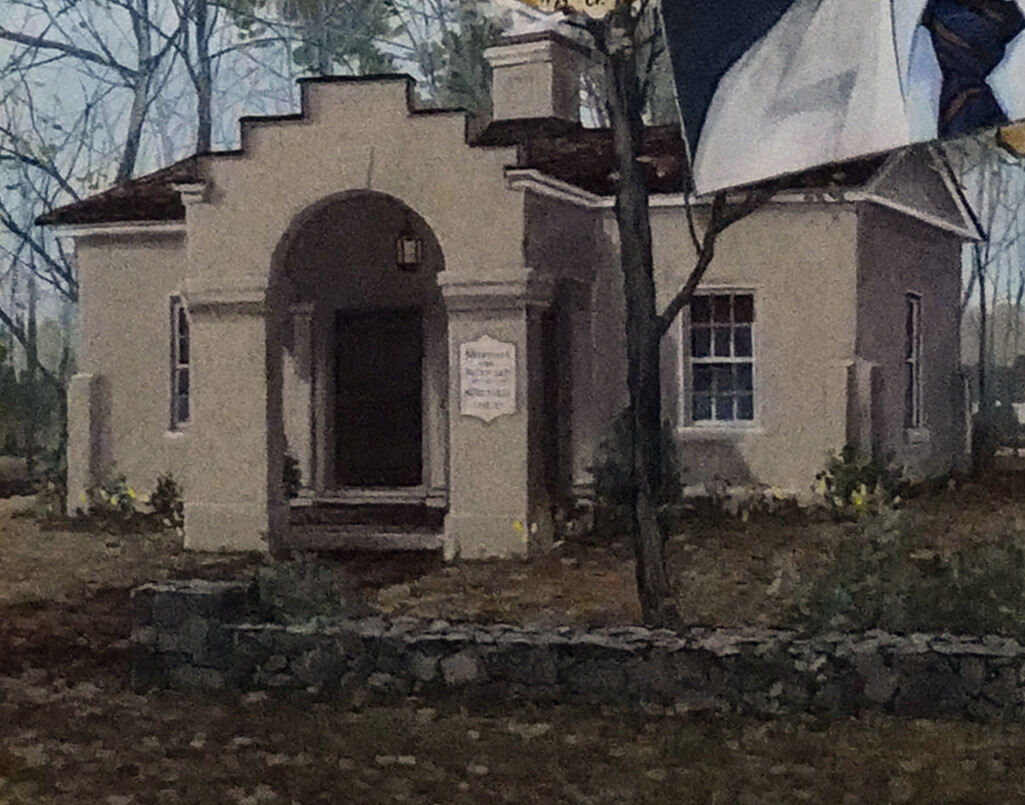
UNC’s first law class was taught in 1845 by William H. Battle in the little building shown in the mural. This building, located at 401 E. Franklin St., was built by Samuel Field Phillips to be his law office, the first law office in Chapel Hill. UNC was one of the early American institutions that introduced law schools, with most of the legal training at the time done through apprenticeships. The program grew steadily until the University was closed during the Civil War.
When UNC reopened after Reconstruction, the law school reopened as well. John Manning became the program’s primary instructor in 1881 and held that position until his death in 1899. During his tenure, he secured official status for the school’s LLB program and ensured the program became its own department at the university.
The 20th century brought many changes to the law school. The first woman to graduate from the program, Margaret Berry Street, did so in 1915. The 1920s saw the program take on more of the characteristics of the modern law school, such as a three year curriculum and a student law journal, the North Carolina Law Review. Since 1928 the school has been approved by the American Bar Association.
In 1951 the law school was integrated following the McKissick v. Carmichael legal case, with five Black men, Harvey Beech, James L. Lassiter, J. Kenneth Lee, Floyd McKissick, and James Robert Walker Jr., entering the program. 1955 saw the first female professor, Mary Oliver, who also served as the law librarian. In 1970 Harry Groves became UNC Law’s first Black professor; Charles E. Daye followed in 1972 as the first Black tenure-track professor. In 1989 Judith Wegner became the school’s first female dean.
The UNC Law School continues operating today, educating future lawyers. There are more than 11,000 alumni across all 50 states and more than 15 countries.