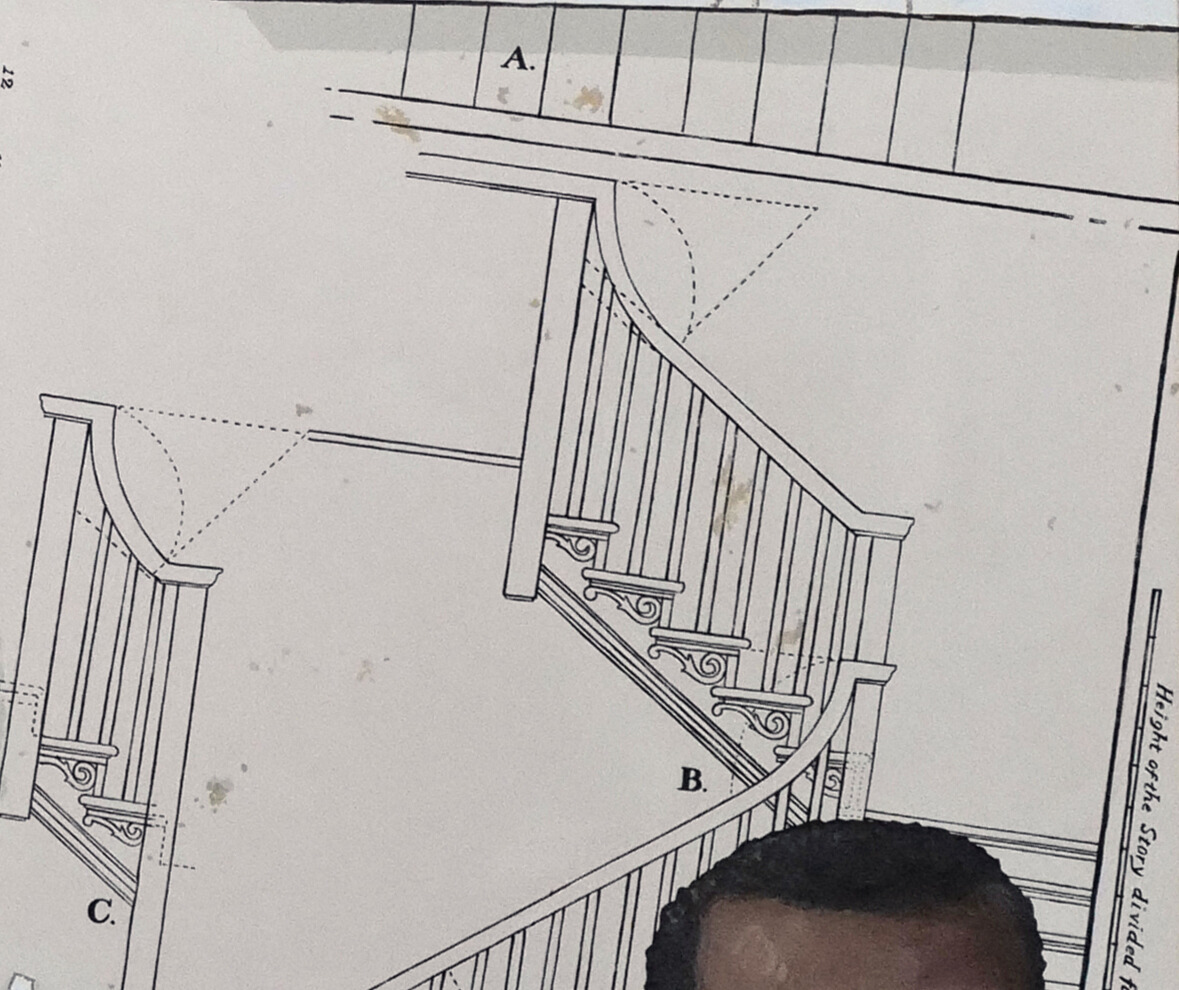
John Berry, a white architect and builder, was born August 18, 1798. In 1805, following the death of his father, Berry’s mother bought a plot of land at Lot 54 of West Queen Street in Hillsborough. A local brick mason, Samuel Hancock, built a house for the Berrys there and it is said that young John helped, gaining an early interest in architecture and construction. While no records of an apprenticeship exist, Berry may have learned his trade from Hancock, as they seem to have worked on several projects together. The Presbyterian Church on Hillsborough’s West Tryon Street may have been a collaboration. As Berry’s career continued, he worked on several projects that brought him into contact with trained architects and built his knowledge base. He also seems to have developed his design skills by reading books, like those of Owen Biddle and Asher Benjamin. Berry’s copy of Owen Biddle’s Young Carpenter’s Assistant is at the UNC-Chapel Hill library.
Berry was involved with several notable buildings, some designed by trained architects and some his own creations. He was engaged in the construction of the Caswell County Courthouse in Yanceyville and the two-story stone jail in Hillsborough. He built the Wake Forest College main building. He had proposed a design that was originally accepted, however, the college trustees switched to a design by a Mr. Ligon. The Old Orange County Courthouse in Hillsborough was designed and constructed by Berry and is generally considered to be his masterpiece. Berry and his associate Henry Richards Sr. built Smith Hall, designed by Alexander Jackson Davis and now known as the PlayMakers Theater, on the UNC campus. The Hillsborough Military Academy and the Commandant’s House in West Hillsborough were both designed by Colonel Charles Courtney Tew and built by Berry and Richards. The Methodist Episcopal church in Hillsborough appears to have been both designed and built by Berry. Additionally, the Hillsborough Baptist Church was designed by William Percival, begun by D. Kistler, and, after various difficulties, completed by Berry.
Berry enslaved more than 40 people. Many of these people were made to work in his building business, with several of them being skilled craftspeople who created many of the details still admired today. These craftspeople included Joseph Nichols, a carpenter, and Ned Haughawout, a tinner.
Berry became increasingly involved in civic affairs in the 1840s. He was repeatedly marshal of Independence Day celebrations, involved with the masons, and a manager of Sunday schools. He was the Town Commissioner of Hillsborough from 1842 to 1847, a member of the North Carolina Constitutional Convention in 1861 and 1865, and served five terms in the North Carolina State Senate and one term in the North Carolina House of Commons. He was also a trustee of Wake Forest College from 1850 to 1862. Berry died of pneumonia in 1870. The Berry family remained prominent in Orange County, with his granddaughters being Harriet Morehead Berry, a leader in the Good Roads movement, and Margaret Berry Street, the first woman to graduate from the UNC Law School.