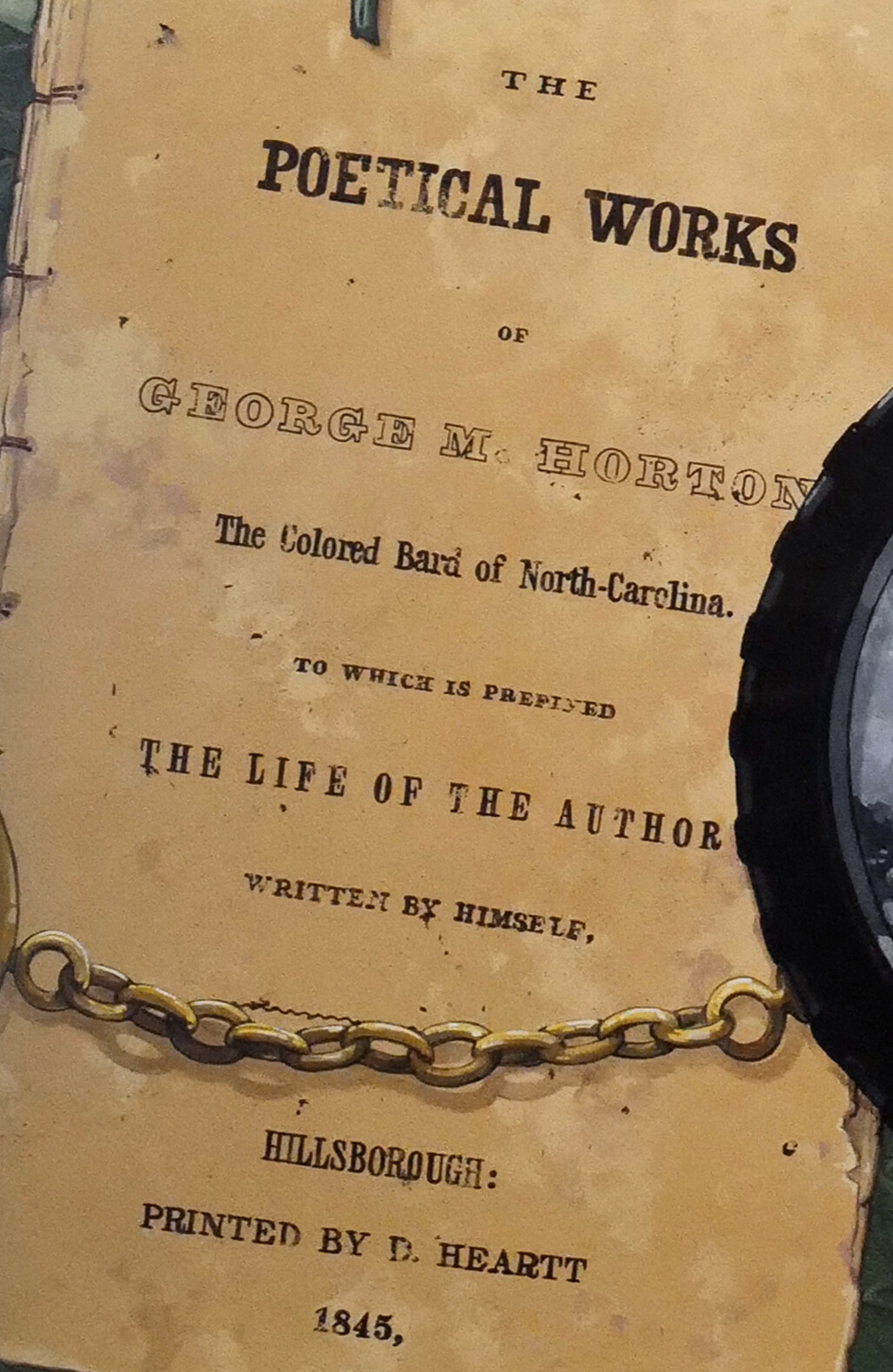
George Moses Horton was a Black poet born around 1797 in Northampton County, North Carolina. He, his mother, five half-sisters, brother, and three sisters were enslaved by William Horton. Early in his life, Horton and his family were moved to Chatham County. As a child, he taught himself to read and began composing poetry in his head, with his early poems being based on the rhymes in the hymns of Charles Wesley.
By the age of 20, Horton had started visiting the UNC campus, delivering farm products. He sold love poems to university students, often acrostics based on the names of their girlfriends. He began attracting fans who would pay for his poems and lend him books. He bought his own time from his enslavers using these earnings.
Horton developed a friendship with Caroline Lee Hentz, a novelist and professor’s wife. She transcribed his poems, assisted in teaching him to write, and worked to have his poetry published. His first published piece was “Liberty and Slavery,” which was published in Hentz’s hometown newspaper, the Lancaster Gazette, on April 8, 1829. This is the first known poem written by an enslaved person that protests slavery. Horton was considered to be a genius in his time and attracted a number of powerful admirers, including politicians, newspapermen, and abolitionists.
Horton hoped to purchase his freedom with profits from his 1829 book, The Hope of Liberty, which was the first book published in the South by a Black man. Unfortunately, its sales were not sufficient to free him from bondage. He published another book of poetry in 1845, The Poetical Works of George M. Horton, The Colored Bard of North-Carolina, To Which Is Prefixed The Life of the Author, Written by Himself. This again failed to raise enough money to buy his freedom. Horton continued to advocate for his freedom, writing to important political and cultural figures asking for aid, but this was also unsuccessful.
Horton spent the Civil War on his enslaver’s farm, before trekking to meet the Union army in Raleigh in 1865. He traveled with the army for several months, during which time he wrote his third and final book of poetry, 1865’s Naked Genius. Following the war’s end, he moved to Philadelphia, where he wrote poems for the newspapers and Sunday school stories. At some point, Horton traveled to Liberia, though he may have returned to Philadelphia. He passed away around the year 1883.